Protein needs are one of the most argued-about numbers in all of nutrition science, mostly because two genuinely different questions get answered with the exact same word: how much protein prevents outright deficiency, and how much protein supports someone actively training. The two answers aren’t the same, and knowing clearly which one applies to you clears up most of the confusion.
The official minimum: 0.8g/kg
The Recommended Dietary Allowance (RDA) for protein is 0.8 grams per kilogram of bodyweight per day for adults, a figure used by MedlinePlus and drawn from the National Academies’ Dietary Reference Intakes. This number is calculated to meet the needs of nearly all healthy, largely sedentary adults — it’s a floor set with a safety margin, not a target calibrated for anyone with an elevated physical demand on their muscle tissue. For a 70kg adult, that works out to 56 grams a day, an amount most people eating a normal mixed diet already reach without trying.
The training range: roughly 1.6-2.2g/kg
Once regular resistance or endurance training enters the picture, the calculation changes. Exercise creates muscle tissue damage that needs repairing, and repeated training drives adaptations that require material to build from — protein supplies that material. Research specifically examining protein needs for people who train regularly, rather than the general sedentary population the RDA was calculated for, points to a meaningfully higher range, commonly cited as roughly 1.6 to 2.2 grams per kilogram. This is the range used across the calculators on this site whenever “training regularly” is selected.
Where you land within that range depends on factors a simple calculator can’t fully see: how hard and how often you train, whether you’re in a calorie deficit (where higher protein helps preserve muscle), and personal preference. Leaning toward the higher end is generally reasonable during a deficit specifically, since adequate protein becomes more important for protecting muscle when overall calories are reduced.
What the numbers look like in grams
Percentages and ranges are easier to act on once they’re converted to an actual daily gram target. Here’s the general minimum against the training range, at a few common bodyweights:
| Bodyweight | General minimum (0.8g/kg) | Training range (1.6-2.2g/kg) |
|---|---|---|
| 55 kg | 44 g | 88-121 g |
| 70 kg | 56 g | 112-154 g |
| 90 kg | 72 g | 144-198 g |
| 110 kg | 88 g | 176-242 g |
The gap between the two columns widens noticeably with bodyweight, which is exactly why a flat “eat 100g of protein a day” rule that ignores bodyweight entirely tends to undershoot badly for a heavier, actively training person, while meaningfully overshooting for a smaller, sedentary one.
Is more always better?
Not meaningfully, past a point. Research on protein intakes above the RDA has not established clear adverse effects for people without pre-existing kidney disease, so there’s no strong evidence that moderately exceeding your target within these ranges causes harm. But there’s also no strong evidence that protein intake far beyond roughly 2.2g/kg produces additional muscle-building benefit for most people — extra protein beyond what your body can use for repair and adaptation is simply used for energy or excreted, not banked as extra muscle. People with existing kidney disease are a genuine exception and should follow their own clinician’s guidance rather than a general range, since protein handling in that situation is different.
Two common myths worth retiring
“Your body can only absorb 20-30 grams of protein per meal” is a claim that circulates widely but overstates what the underlying research actually shows. Digestion and absorption of amino acids continue for hours after a meal, and the body doesn’t simply discard protein beyond some fixed per-meal ceiling — what changes is the rate and pattern of muscle protein synthesis afterward, a more gradual effect than a hard cutoff implies. It’s a reasonable simplification for meal planning, not a hard biological limit — though the simplification itself shifts with age: the research behind that 20-30g figure is drawn mostly from younger adults, and older adults genuinely need more per meal to trigger the same response, for reasons distinct from this myth.
The second is the idea that high protein intake damages healthy kidneys. As covered above, this concern applies specifically to people with pre-existing kidney disease, where protein handling is genuinely altered. For people without kidney disease, research has not established that protein intake within the ranges discussed here causes kidney damage — a distinction that gets lost when the caution aimed at one group gets generalized to everyone.
Does the source of protein matter?
Total daily amount matters more than any single food choice, but source affects efficiency to a degree. Animal proteins are typically “complete,” containing all essential amino acids in the proportions the body needs from a single source. Many plant proteins are complete too; others become complete when combined across a day — the classic example being beans and rice, which together supply what either lacks alone. For most people eating a varied diet across the day, this resolves itself without deliberate planning.
People eating fully plant-based diets can still reach the training range comfortably, though it may take slightly more deliberate planning to hit a higher daily target from plant sources alone, simply because many whole plant foods are less calorie- and protein-dense per gram than something like chicken breast or eggs. Legumes, tofu, tempeh, seitan, and protein-fortified foods all help close that gap without requiring a fundamentally different overall approach — the underlying gram target explained throughout this article doesn’t change based on which broad diet pattern you happen to follow. For a closer look at hitting a target this way without relying on powders or bars, see Hitting Your Protein Target as a Vegetarian.
Why training status changes the number, not just intensity
It’s worth being specific about what “training regularly” means for this calculation, since the distinction isn’t about intensity alone. Someone doing occasional light activity without structured resistance or endurance training is still best served by the general 0.8g/kg minimum — the higher range is calibrated for the repeated muscle tissue stress and repair cycle that comes specifically from consistent structured training, not from general daily movement or occasional exercise. Someone starting a brand-new training program should generally expect their protein needs to shift into that higher range fairly quickly, typically within the first few weeks of consistent structured training, rather than needing to slowly build up to it over many months.
Putting it into practice
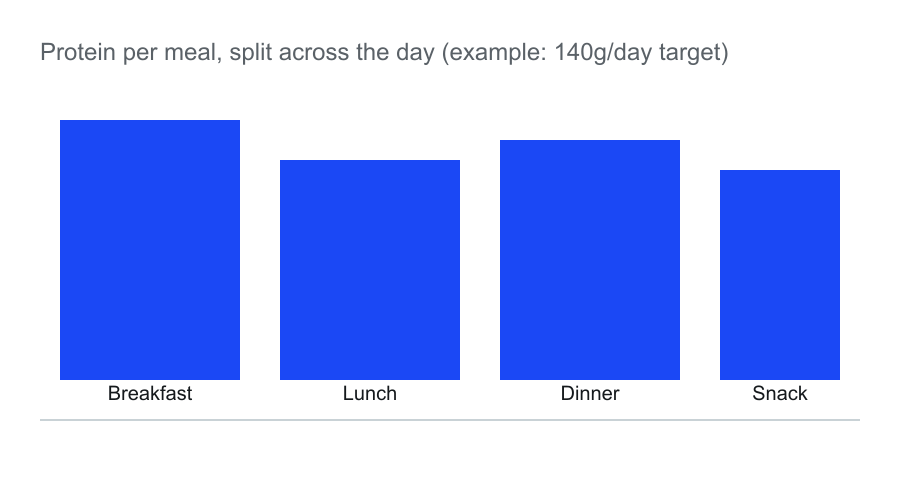
Hitting a daily total matters more than precise timing, but spreading intake across three to five meals rather than one or two makes a higher target easier to reach in practice, since it reduces how much any single meal needs to carry. The example above splits a 140g daily target unevenly on purpose — a smaller breakfast, larger lunch and dinner, and a snack to round out the day — since real eating patterns rarely divide protein into perfectly equal portions, and there’s no requirement that they should.
If you know your bodyweight and whether you train regularly, the protein calculator on this site applies exactly the two reference points explained here — the 0.8g/kg general minimum, or the 1.6-2.2g/kg training range — directly and transparently to your own numbers, without inventing a false sense of precision beyond what the underlying published research actually supports.
There’s a third situation the two reference points above don’t quite cover: an energy deficit that isn’t a deliberate diet, like the appetite suppression that comes with a GLP-1 medication such as Ozempic or Wegovy. That case calls for a range in between the two — higher than the general minimum, since a sustained deficit is exactly when protein matters most for preserving muscle, but not necessarily all the way to the training range if structured resistance training isn’t part of the picture too. (If you’re specifically weighing how much of that concern is actually justified, the research disagrees with itself more than most coverage lets on.)