These GLP-1 usage statistics, drawn from two named 2025/2026 polls, put current use at roughly 1 in 8 US adults. Gallup’s July 2026 poll puts current use at 11%, up from 3% in 2024. KFF’s separate November 2025 poll, fielded roughly seven months earlier, puts it at 12%. Neither figure is wrong. They are two independently fielded surveys measuring closely related but not identical questions, and this article keeps them side by side instead of merging them into one.
Key Findings
- 11% of US adults currently take a GLP-1 for weight loss, per Gallup’s July 2026 poll, up from 3% in 2024.
- 12% of US adults currently take a GLP-1 for any reason (weight loss, diabetes, or another condition), per KFF’s separate November 2025 poll.
- 22% of adults ages 50-64 currently take a GLP-1, the highest of any age group KFF measured, versus 9% of adults 65 and older.
- 45% of adults who say they’ve been diagnosed with diabetes are currently using a GLP-1, per KFF, the highest usage rate of any condition group.
- 68% vs. 19%: the split between brand-name and compounded GLP-1 use among Gallup’s current users, with switching flowing mostly from brand-name toward compounded (35%), largely over cost.
- 56% of GLP-1 users, including 55% of insured users, say the drugs are difficult to afford, per KFF.
How Many Americans Are Currently Taking a GLP-1 Drug in 2026?
Two reputable pollsters, two different numbers, both real. Gallup’s Gallup Panel survey, fielded May 28-June 5, 2026, found 11% of US adults currently taking a GLP-1 medication for weight loss, with 15% reporting they’ve used one at some point. KFF’s Health Tracking Poll, fielded October 27-November 2, 2025 (roughly seven months earlier, asking about GLP-1 use for weight loss, diabetes, or any other condition instead of weight loss specifically), found 12% currently taking one, with 18% reporting lifetime use.
| Gallup | KFF | |
|---|---|---|
| Currently taking a GLP-1 | 11% | 12% |
| Ever taken a GLP-1 | 15% | 18% |
| Survey window | May 28-Jun 5, 2026 | Oct 27-Nov 2, 2025 |
| Sample size | 5,065 US adults | 1,350 US adults |
| Method | Gallup Panel, probability-based web survey | Online and telephone, English and Spanish |
| Margin of error | ±1.5 percentage points | ±3 percentage points |
| What’s asked about | GLP-1 use specifically for weight loss | GLP-1 use for weight loss, diabetes, or another condition |
The gap between 11% and 12% is small enough to sit inside normal survey noise, but the two polls aren’t measuring the exact same thing, which is covered in full in the methodology section below. Read either number as roughly “1 in 8 to 1 in 9 US adults,” not as two disagreeing readings of one true figure.
GLP-1 Usage by Age and Sex
KFF’s poll breaks current use down by both sex and age, and the pattern is fairly pronounced on both counts. Women currently take a GLP-1 at nearly double the rate of men, and usage peaks in middle age instead of climbing steadily with it.
| Group | Currently taking a GLP-1 (KFF) |
|---|---|
| Women | 15% |
| Men | 9% |
| Adults 50-64 | 22% |
| Adults 65+ | 9% |
The age pattern likely has a structural explanation more than a purely behavioral one: KFF notes that lower use among adults 65 and older likely reflects Medicare’s lack of coverage for GLP-1 drugs prescribed specifically for weight loss, rather than necessarily lower interest or need in that group. Among people who haven’t taken a GLP-1 at all, KFF found about 1 in 5 (22%) say they’d be interested in taking one for weight loss, including 7% who describe themselves as “very interested.” Demand among non-users extends well past the 65-and-older group, where coverage is the likely bottleneck.
GLP-1 Usage by Health Condition: Diabetes vs. Obesity or Overweight
GLP-1 drugs were originally developed for diabetes management before their weight-loss use expanded rapidly, and KFF’s data still shows that history in the usage numbers. People who report being diagnosed with diabetes have both the highest ever-used and highest current-use rates of any condition group.
| Diagnosed condition | Ever used a GLP-1 | Currently using |
|---|---|---|
| Diabetes | 57% | 45% |
| Heart disease | 40% | 29% |
| Obese or overweight (past 5 years) | 34% | 23% |
For context on the broader population these condition-specific numbers sit inside, Gallup’s separate tracking data (drawn from a larger, two-quarter sample of 10,091 respondents instead of the GLP-1 question’s own 5,065) put the 2026 US adult obesity rate at 36.4%, down from a record peak of 39.9% in 2022. Gallup doesn’t attribute that decline to GLP-1 use directly in this release, and this article isn’t claiming a causal link either — the obesity-rate figure is included here only as population-level context for how large the “obese or overweight” group in the condition table above actually is.
If you’re in the group currently managing weight loss on a GLP-1, appetite suppression changes how much protein you need day to day. See how much protein on GLP-1 medications for the specific gram target the research supports, and does Wegovy really cause muscle loss for what happens to lean mass specifically during that kind of deficit. For the science behind that appetite suppression itself, and a newer 2026 Yale study that suggests the mechanism may be more complex than previously thought, see how GLP-1 drugs actually work.
Brand-Name vs. Compounded GLP-1 Use, and Why People Switch
Among Gallup’s current users, brand-name medications (Ozempic, Wegovy, Mounjaro, Zepbound) still dominate, but compounded (pharmacy-mixed) versions have a real, non-trivial share.
| Brand-name | Compounded / custom-mixed | |
|---|---|---|
| Share of current users | 68% | 19% |
| Rate “extremely effective” | 32% | 39% |
| Rate “effective” or “extremely effective” | 74% | 77% |
Self-reported effectiveness runs slightly higher among compounded users than brand-name users in this data, which is worth noting without over-reading: this is a perception measure from a survey rather than a clinical outcome comparison, and compounded formulations aren’t standardized the way FDA-approved drugs are.
Switching between the two runs heavily in one direction. Gallup found 35% of current compounded users say they switched from a brand-name product, versus only 10% of brand-name users who switched from compounded. Among people who moved from brand-name to compounded, 66% cite cost or insurance coverage as their primary reason, compared with 34% of people who moved the other way. Cost, more than effectiveness, appears to be the main force pushing people toward compounded formulations. That same cost pressure is behind a newer, related trend neither poll measures directly: GLP-1 microdosing, taking less than the lowest approved dose to stretch a prescription, which carries its own evidence and safety gaps separate from standard compounded use. If cost pressure is part of what eventually leads to stopping a GLP-1 altogether, weight regain after stopping GLP-1 medications covers what the research shows happens next and how to recalculate your numbers before tapering off.
Can People Afford Their GLP-1 Medication?
Affordability is where KFF’s poll adds the most texture Gallup’s release doesn’t cover. More than half of current GLP-1 users say the cost is a real burden, regardless of insurance status.
| Affordability measure (KFF) | Share |
|---|---|
| Say the drugs are difficult to afford | 56% |
| …among users with insurance specifically | 55% |
| Insured users who paid the full cost themselves | 27% |
| Stopped taking a GLP-1 due to cost | 14% |
| Stopped taking a GLP-1 due to side effects | 13% |
Where people get their GLP-1 also varies. Most people get it the conventional way, through a doctor (76%). Another 17% report getting it from an online provider or website, and 9% from a medical spa or aesthetic medical center. That acquisition mix matters for the affordability numbers above: people going through less traditional channels aren’t necessarily the ones driving the 56% affordability-difficulty figure, but the two data points sit in the same poll and reflect the same broader picture of people finding varied paths to a medication that’s expensive through the standard channel.
If you’re currently on a GLP-1, whichever version or channel you got it through, protein needs stay the same. The protein calculator applies the same 1.0-1.6g/kg research-backed range to your own bodyweight, regardless of brand or compounded status.
How GLP-1 Usage Has Changed Since 2024
Gallup’s own trend data is the clearest single number in either poll: current use for weight loss purposes rose from 3% in 2024 to 11% in 2026, a nearly fourfold increase in two years. Awareness of GLP-1 drugs climbed alongside it, from 80% in 2024 to 91% in 2026, though at a much slower rate than actual use did.
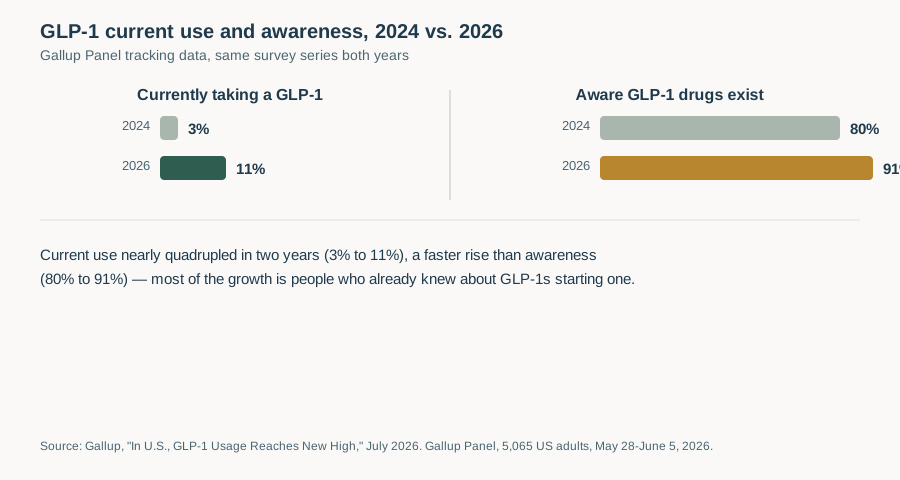
That gap between the two growth rates is itself informative. Awareness was already near-universal by 2024 and had less room left to grow; use kept climbing well past that point. Most of the recent growth comes from people who already knew GLP-1 drugs existed and only recently started one — the drugs didn’t suddenly become better known. Gallup’s data doesn’t break out why that shift accelerated when it did, so this article isn’t speculating on the specific cause, only reporting the trend as measured.
Methodology: How Gallup and KFF Each Measured This
These are two separate, independently fielded polls, not two cuts of the same underlying survey. The small headline gap between them (11% vs. 12%) reflects real methodological differences rather than either poll being more accurate.
Gallup ran its GLP-1 questions as part of the Gallup National Health and Well-Being Index, a web survey of 5,065 US adults conducted May 28-June 5, 2026, drawn from the probability-based Gallup Panel covering all 50 states and the District of Columbia. The margin of sampling error is ±1.5 percentage points at the 95% confidence level for the full sample, though Gallup notes subgroup margins run considerably wider, as much as ±10 percentage points for the compounded-medicine user subgroup specifically, since that’s a much smaller slice of the total sample. Gallup asked specifically about “weight loss medications such as semaglutide (brand names Ozempic and Wegovy), liraglutide (brand name Saxenda) or tirzepatide (brand names Mounjaro and Zepbound),” a question scoped to weight-loss use.
KFF fielded its Health Tracking Poll October 27-November 2, 2025, online and by telephone, in English and Spanish, among a nationally representative sample of 1,350 US adults, with a margin of sampling error of ±3 percentage points for the full sample. KFF’s question asked about GLP-1 drug use more broadly, “for weight loss, diabetes, or another condition,” not weight-loss use alone.
Two differences plausibly explain the small gap in headline numbers: KFF’s question casts a wider net (any condition, not just weight loss), while Gallup’s survey is roughly seven months more recent on a fast-rising trend. Those two effects likely partially offset each other, which is part of why 11% and 12% land as close together as they do despite measuring somewhat different things at somewhat different times. Neither poll cross-references the other — this article is the one drawing that comparison.
Limitations
- Both figures are self-reported, not drawn from pharmacy or insurance claims data. Self-report surveys carry normal risks of recall error and social-desirability bias, in either direction.
- Gallup and KFF are not directly comparable surveys. Different sample sizes, fielding windows roughly seven months apart, different question wording, and different modes (web-only vs. online-and-telephone) mean the 11%/12% gap can’t be resolved into a single “true” number. It isn’t meant to be.
- Subgroup breakdowns carry wider margins of error than the headline figures. Gallup states its compounded-user subgroup margin runs as high as ±10 percentage points; small-group breakdowns anywhere in this article should be read as directional, not precise to the percentage point.
- Neither poll breaks results out by individual brand (Ozempic vs. Wegovy vs. Mounjaro vs. Zepbound); both report at the brand-name-versus-compounded or condition level only.
- This is a fast-moving topic. Gallup’s own data shows current use nearly quadrupling in two years; figures this article cites as “current” will likely be dated within another year or two given that pace.
- Affordability figures reflect perception, not a standardized cost-burden calculation. “Difficult to afford” is self-assessed by respondents rather than measured against income or a fixed cost threshold.
Neither poll is written for a nutrition-focused reader, and neither tells you what to actually eat while taking one of these medications or after stopping. For that, see Mounjaro side effects: what to eat for each one if GI side effects are the immediate issue, or weight regain after stopping GLP-1 medications if you’re further along and thinking about tapering off.