Most people regain some weight after stopping a GLP-1 medication such as Wegovy, Ozempic, Zepbound, or Mounjaro, because appetite-suppressing effects fade once the drug clears the body. How much varies widely by study: trial data shows regain of roughly 9.9kg in the first year, while Cleveland Clinic’s real-world data found 45% of patients held steady or kept losing.
What Happens to Your Weight After Stopping a GLP-1?
Weight typically starts climbing back within weeks of the last dose, as appetite returns and the drug’s effect on gastric emptying and “food noise” fades. What’s less consistent is how much comes back and how fast — the published numbers don’t agree with each other, and that disagreement itself is informative.
A systematic review and meta-analysis published in BMJ, covering 37 studies and 9,341 participants and reported on by TCTMD, found that people stopping semaglutide or tirzepatide regained an average of 9.9kg in the first year — about 0.8kg a month — against an average of 14.7kg lost during treatment with these newer incretin-based drugs. Time to return to starting weight averaged 1.5 years for this drug class, compared with roughly 4 years after stopping behavioral weight-loss programs, a notably slower path back. The same review tracked cardiometabolic markers, not just weight: HbA1c, systolic blood pressure, and diastolic blood pressure all trended back toward pre-treatment levels within roughly a year to 14 months of stopping.
A separate meta-regression, covering 48 studies with a core analysis of 6 randomized trials and 3,236 participants, and reported by News-Medical, modeled the shape of that regain rather than just an endpoint: it found people regain weight quickly at first, then decelerate, ending up with roughly 60% of the lost weight back within a year and settling toward about 75% regained over the longer term — meaning roughly a quarter of the original loss persisted in this dataset.
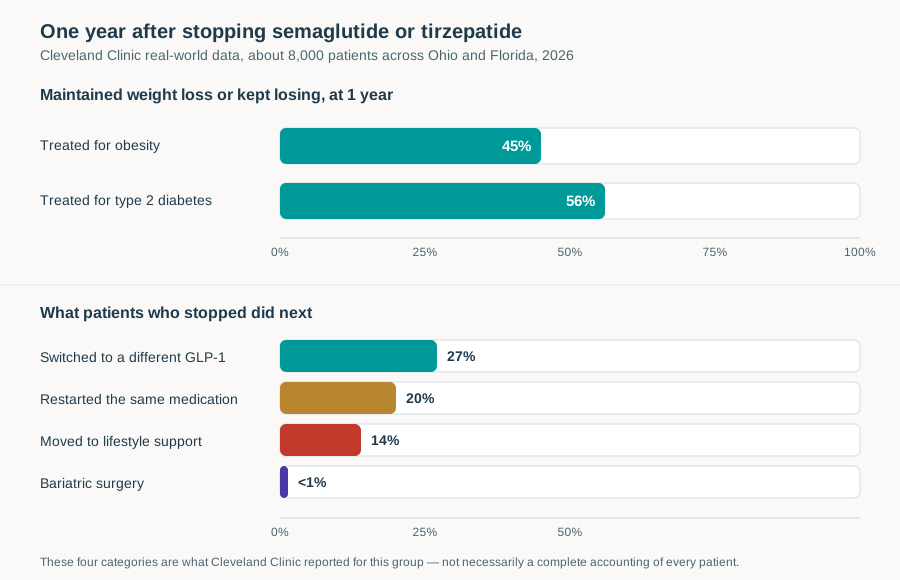
Real-world data tells a different story. Cleveland Clinic tracked nearly 8,000 patients across Ohio and Florida who stopped semaglutide or tirzepatide after 3 to 12 months of treatment. Among those originally treated for obesity, the average net change at one year was a regain of just 0.5% of body weight — far smaller than the trial-based estimates above — and 45% had maintained their loss or kept losing. Among those treated for type 2 diabetes, 56% maintained or continued losing, with an average additional 1.3% lost at one year.
| Trial meta-analysis (TCTMD) | Trial meta-regression (News-Medical) | Real-world data (Cleveland Clinic) | |
|---|---|---|---|
| Sample | 9,341 participants, 37 studies | 3,236 participants, 6 RCTs (core model) | ~8,000 patients, Ohio and Florida |
| Weight lost during treatment | 14.7kg average | 15-20% of body weight | 8.4% average (obesity group) |
| Regain at ~1 year | 9.9kg average | ~60% of weight lost | 0.5% net regain (obesity group) |
| Share who avoided regain | Not reported this way | Not reported this way | 45% maintained or kept losing |
Why the gap? Trials measure people who, by design, mostly stop the drug and little else changes in how they’re studied. Real-world patients who stop often also switch medications, restart, or start working with a dietitian — the Cleveland Clinic data captured exactly that mix, covered below. The honest takeaway isn’t one number; it’s that regain is common and worth planning for, but the size of it depends heavily on what happens next, which is something you have some influence over.
Why Does Weight Come Back After Stopping Wegovy, Ozempic, Zepbound, or Mounjaro?
Semaglutide (Wegovy, Ozempic) and tirzepatide (Zepbound, Mounjaro) don’t work by burning fat directly. The core mechanism is appetite suppression: they mimic gut hormones that signal fullness, and they slow how fast the stomach empties, both of which make it easier to eat less without constant hunger. That’s still accurate, but it may not be the whole story. A 2026 Yale study, so far only in mice, suggests these drugs may also recruit hunger-signaling neurons rather than simply quieting them, triggering a metabolic response similar to natural calorie restriction. How GLP-1 drugs actually work covers that newer research and what it does and doesn’t establish. Once the drug clears the body, the established appetite-suppressing effects fade, and appetite-regulating hormones move back toward where they were before treatment.
Dr. Susan Gasparino of University of Rochester Medicine frames the resulting hunger increase as biology working as designed, not a sign anything went wrong: “The human body has many mechanisms in place to protect against what it perceives as undernutrition.” A body that has lost a meaningful amount of weight responds by producing more hunger-signaling hormones and fewer fullness-signaling ones — a defense against what it reads as a shortage, regardless of whether the weight loss was intentional and healthy.
This is also why several of the clinicians behind the research above describe obesity using a chronic-disease framework rather than a one-time-fix model. Dr. Michael Miedema, quoted in TCTMD’s coverage of the meta-analysis, makes the same point using cholesterol-lowering therapy: stop that treatment and cholesterol levels rise again, the same way stopping a GLP-1 lets weight and cardiometabolic markers drift back — not because anything failed, but because the underlying condition is still there once the medication is gone. That framing matters for how to think about “failure” here — regain reflects biology returning to its prior state, not a lack of willpower.
Bariatric surgeons make a related point from the other side of the treatment comparison. Dr. Aftab Jafri, an advanced GI and bariatric surgeon at MUSC Health, frames it plainly: weight loss on a GLP-1 “is dependent on continued therapy; patients do well while taking the medication, but significant weight regain is common once treatment is stopped.” That’s part of why MUSC’s team treats GLP-1s and bariatric surgery as complementary options rather than one universal answer — which one, if either, fits depends on your BMI, comorbidities, and goals, and is a conversation for your doctor.
Will I Have to Take Wegovy or Zepbound Forever?
There’s no single answer, and this article can’t give you one for your own situation — that’s a conversation for whoever manages your prescription, weighing your health history, how you responded to treatment, cost, and your own goals. What the research above does support is that these medications currently work the way most chronic-disease medications work: the benefit is tied to continued use, and stopping tends to let the underlying condition — in this case, the body’s hunger and fullness signaling — drift back toward baseline over the following one to two years.
Some people do stop entirely and keep most of their results, particularly the 45-56% in Cleveland Clinic’s real-world data who maintained or kept losing weight after stopping. Others find the medication is something they need long-term, the same way someone with a chronic condition might stay on a maintenance medication indefinitely. Neither path is a better or worse outcome on its own — it depends on your body’s response and what your care team recommends.
While you’re still on the medication, Zepbound diet plan: eating structure, day by day covers what a day of eating can look like while appetite is suppressed — useful groundwork before the recalculation below, whenever tapering becomes the next step.
Can I Lower My Dose to Maintain Weight Loss?
Dose reduction, rather than full discontinuation, is a strategy some prescribers use, but it’s a clinical decision that depends on factors this article has no way to know about you — your response so far, side effect history, and what your insurance will cover at a lower dose. This isn’t something to adjust on your own.
What Cleveland Clinic’s real-world data shows is that “stopping” often isn’t a single, final event for most patients. Among nearly 8,000 people who stopped their original prescription, 27% switched to a different GLP-1 or weight-management medication, 20% restarted the same medication, 14% moved to lifestyle-modification support with a healthcare professional, and fewer than 1% pursued bariatric surgery. Dose adjustment sits alongside these as one more option worth raising directly with your prescriber, particularly if cost is what’s forcing the issue rather than a decision to stop treatment altogether. That’s a different path from the self-directed “microdosing” trend circulating online: see GLP-1 microdosing and your calorie targets for why a supervised dose reduction and an unsupervised compounded microdose aren’t the same thing, evidence-wise.
Recalculating Your Calorie and Protein Targets Before You Taper
This is the part most coverage of GLP-1 discontinuation skips: what to actually eat once appetite returns. Two numbers are worth recalculating, and neither is the number you were eating on the medication.
Your maintenance calories have likely changed. If you’ve lost weight, your body now needs somewhat fewer calories to maintain itself than it did at your starting weight — a lighter body generally has a lower resting energy need and burns somewhat less in daily movement. Continuing to eat at your old, pre-treatment intake once appetite returns is a direct route to faster regain; eating at your suppressed, on-drug intake indefinitely isn’t sustainable as appetite comes back either. The number worth aiming for is your maintenance calories at your current weight, recalculated fresh rather than assumed.
Your protein target should carry forward, not drop off. How much protein you need on GLP-1 medications covers the research behind a 1.0-1.6 gram-per-kilogram range for protecting muscle during a GLP-1-driven deficit. That range doesn’t stop mattering once you stop the medication — if anything, it matters more during the return of a normal appetite, since protein’s satiety effect is one of the few tools that helps offset appetite rebound without another prescription. Does Wegovy really cause muscle loss covers why pairing that protein target with resistance training, rather than protein alone, is what the research consistently points to for preserving the muscle you have as your eating pattern shifts.
Here’s what that recalibration can look like, illustratively — use your own numbers rather than these:
| Example A | Example B | |
|---|---|---|
| Weight before treatment | 200 lb (91 kg) | 160 lb (73 kg) |
| Weight after a hypothetical 15% loss | 170 lb (77 kg) | 136 lb (62 kg) |
| Illustrative maintenance calories at new weight, moderate activity | ~2,300-2,550 kcal/day | ~1,850-2,050 kcal/day |
| Protein target (1.0-1.6 g/kg) | 77-123 g/day | 62-99 g/day |
These figures are illustrative only, based on typical ranges for a moderately active adult at each weight — they aren’t personal recommendations. This site never suggests a target below 1,500 kcal for men or 1,200 kcal for women, and a deficit larger than 750 kcal a day carries enough added risk of muscle loss and rebound hunger that it isn’t a starting default here.
Use the TDEE calculator to get your own maintenance number from your current age, sex, height, weight, and activity level, and the protein calculator to apply the 1.0-1.6g/kg range to your own bodyweight. If your goal through the taper is to hold your loss rather than lose further, the maintenance calorie calculator is built for exactly that target rather than a deficit.
What Can I Do to Keep Weight Off After Stopping?
University of Rochester Medicine’s guidance centers on building these habits before you stop, not scrambling to start them afterward: balanced meals emphasizing protein and fiber, consistent exercise, adequate sleep, stress management, and a support system that can include a dietitian or mental health provider. On exercise specifically, the CDC’s general minimum is 150 minutes of moderate activity a week, though people who maintain weight loss long-term tend to average closer to 300 minutes weekly, per the same reporting.
Resistance training deserves a specific mention here, separate from cardio: it’s the other half of the muscle-preservation picture alongside protein, and it matters just as much after stopping as it did during treatment. See does Wegovy really cause muscle loss for what the actual research shows about training and lean mass during a GLP-1-driven deficit — the same logic applies once appetite returns and your eating pattern shifts again.
As the URMC piece puts it plainly: “These medications are a tool… The lifestyle habits you build alongside them are what support long-term success.” None of this guarantees zero regain — biology is working against you here, per the hormone changes covered above — but it’s the set of levers the research consistently points back to, rather than anything specific to any one medication.
Legitimate Reasons You Might Need to Stop
Not every reason to stop is a choice, and none of the reasons below are a personal failure.
Insurance or cost. This was the dominant reason patients stopped in Cleveland Clinic’s real-world dataset, ahead of side effects — consistent with broader polling on GLP-1 affordability, where cost was also the single most common reason survey respondents gave for stopping. If your coverage changes or a prior authorization lapses, raise it with your prescriber as early as possible — they may know of manufacturer savings programs, formulary alternatives, or a dose adjustment worth trying before the medication runs out entirely.
Pregnancy planning. If you’re planning a pregnancy, GLP-1 medications are generally not continued through that period. The timing and how to transition off is a conversation for your prescriber and OB-GYN together, not something to plan from a general article — every situation and timeline is different.
Upcoming surgery. Surgery and anesthesia teams sometimes ask patients to pause a GLP-1 before a procedure, related to the same slowed gastric emptying discussed above. Exact timing guidelines vary and change over time, so rather than repeat a specific number here, treat this as a topic to raise with your surgical team and prescriber directly during pre-operative planning, not a general rule to apply on your own.
Can I Restart If I Regain Weight?
Generally, yes, and it’s a common path rather than a rare one. In Cleveland Clinic’s real-world data, 20% of patients who had stopped went on to restart the same medication, and another 27% switched to a different GLP-1 or weight-management drug. Whether restarting is right for you depends on why you stopped in the first place — cost and access, side effects, or a planned pause — and that’s a conversation to have directly with your prescriber, who can weigh your specific history in a way this article can’t.
Talk to Your Prescriber Before You Decide
Everything above is general, population-level information drawn from published research and real-world data, not a plan tailored to your prescription, your dose, your labs, or any other condition you’re managing. Whether to stop, taper, lower your dose, or restart a GLP-1 medication is a decision to make with whoever prescribes it, not from an article. If you notice weight regain happening unusually fast, alongside other symptoms, or in a way that concerns you, that’s worth raising with your prescriber directly rather than waiting it out.