Creatine monohydrate is among the most studied sports supplements, and research on creatine side effects shows a strong safety record at typical doses of 3-5 grams a day. The only side effect confirmed consistently across decades of research is short-term water retention, roughly 0.5 to 1 kilogram. Claims linking it to kidney damage, dehydration, or cramping have not held up in controlled studies.
What Does Creatine Do to Your Body?
Creatine is a compound made from three amino acids. Your body produces roughly half of what it needs on its own, mainly in the liver, kidneys, and pancreas, and gets the rest from food, mostly red meat and seafood. Once absorbed, most of it is stored in skeletal muscle as phosphocreatine, a fast-access energy reserve.
During short, intense efforts — a heavy set, a sprint, a jump — muscle burns through its immediate energy supply (ATP) in seconds. Phosphocreatine helps regenerate that ATP quickly, which is why creatine supplementation mainly improves performance in short, repeated, high-effort activity rather than long steady-state endurance work. Supplementing raises the muscle’s phosphocreatine pool above what diet alone typically provides, which is the mechanism behind most of its studied benefits: modest gains in strength, power output, and muscle mass when paired with resistance training, and, in a smaller but growing body of research, some benefit to brain energy metabolism as well. Because those muscle-building gains depend on eating enough protein to support them, it’s worth checking your own target with the protein calculator if you’re adding creatine to a resistance-training routine.
People who eat little or no meat or fish start with lower muscle creatine stores than omnivores — one position stand from the International Society of Sports Nutrition (ISSN) puts vegetarians’ baseline muscle creatine content noticeably below the typical omnivore range — which is one reason vegetarians and vegans sometimes see a more pronounced response to supplementation than people already getting creatine from food.
Nearly everything in this article refers to creatine monohydrate specifically, because that’s almost entirely what the safety research has been conducted on. The same ISSN position stand describes creatine monohydrate as the most extensively studied and clinically effective form available, and states directly that marketing claims for alternative forms — creatine HCl, ethyl ester, buffered or “pH-corrected” versions, creatine nitrate — promising better absorption or less bloating than monohydrate are currently unfounded; none has been shown to produce greater muscle creatine retention than plain monohydrate. That matters for a safety article specifically: the reassuring safety data covered below applies to the form that’s actually been tested, not necessarily to every newer variant sold alongside it.
Is Creatine OK to Take Every Day?
Yes, for most healthy adults. The standard daily dose used across the research is 3-5 grams, taken every day, indefinitely, without a required break. The ISSN’s position stand describes both short- and long-term daily use — including doses far above the typical range, up to 30 grams a day for five years in some studied populations — as safe and well tolerated in healthy individuals and in a number of patient populations.
There are two common ways to reach a steady, saturated muscle creatine level:
| Approach | Dose | Time to full saturation |
|---|---|---|
| Loading phase | About 0.3g per kg of bodyweight per day, split into 3-4 servings, for 5-7 days | Roughly one week |
| Maintenance dose from day one | 3-5g per day, no loading | Roughly 3-4 weeks |
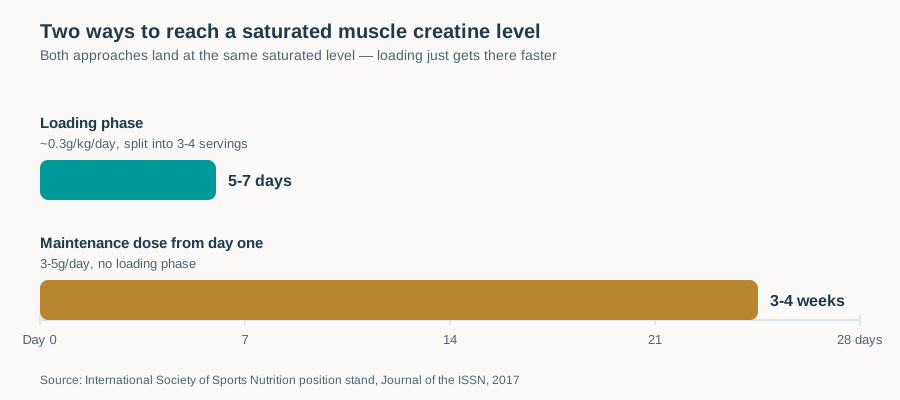
Both approaches land at the same saturated muscle creatine level eventually; loading just gets there faster. Neither is required — skipping the loading phase and taking 3-5g daily from the start is a perfectly reasonable, slightly slower route to the same place, and it tends to cause less of the early water-weight bump some people notice during loading.
In late 2020, the FDA classified creatine monohydrate as generally recognized as safe (GRAS), a classification a 2021 expert review notes extends to older children and adolescents, though it doesn’t cover infants or young children. “Safe” in this context means safe at the doses and forms actually studied — it isn’t a blanket statement covering every proprietary blend, added stimulant, or mega-dose product sold under the same name, which is worth remembering when comparing a plain-monohydrate tub to a pre-workout blend that lists creatine as one ingredient among many.
Common Digestive Side Effects
Digestive upset — bloating, mild nausea, loose stools — is the side effect people ask about most after water weight, and it’s real for some users, even though it isn’t universal. A 2021 review of the research literature found that well-controlled clinical studies have generally refuted the idea that creatine reliably causes gastrointestinal upset at typical doses. Cleveland Clinic’s patient-facing guidance still lists nausea, vomiting, and diarrhea among the possible side effects worth knowing about, particularly during a loading phase, when the total daily dose is highest.
The practical pattern seems to be dose-dependent rather than universal: symptoms show up more often with large single servings (the higher end of a loading dose taken all at once) than with the smaller, steady 3-5g maintenance amount. Splitting a loading dose into 3-4 smaller servings across the day, taking creatine with food, using a micronized form that dissolves more completely in water, and drinking enough water alongside it are all reasonable, low-effort ways to reduce the odds of digestive discomfort. A 2025 expert review also notes that combining creatine loading with a regular caffeine habit may modestly add to digestive discomfort for some people — worth knowing if you already drink coffee or a pre-workout product and are starting a loading phase at the same time.
Because creatine’s most consistently confirmed side effect is water retention, it’s worth knowing your own baseline fluid needs before you start. The water intake calculator gives you a daily target from your bodyweight and training time, and our guide to daily hydration covers how to build that into a normal day.
Can Creatine Cause Muscle Cramps?
The evidence points the other way. A commonly cited study of NCAA football players found that creatine users reported significantly less cramping, and fewer heat illnesses and dehydration episodes, than non-users over a full season — the opposite of the cramping reputation creatine has picked up online. A 2021 expert review summarizing this and other controlled research concluded that the evidence doesn’t support the idea that creatine supplementation causes dehydration or muscle cramping, and some researchers have floated the opposite hypothesis: that better-hydrated muscle cells, a downstream effect of creatine’s own water-retention property, may actually be part of why cramping trends lower rather than higher in supplemented athletes.
That doesn’t mean cramping never happens to anyone taking creatine — plenty of things cause cramps, including under-hydration, electrolyte imbalance, and simple overexertion during a hard block of resistance training, all of which can coincide with someone starting a new supplement and a new training block at the same time. It means the controlled research hasn’t found creatine itself to be the cause, and the largest, best-designed studies point in the opposite direction.
Does Creatine Affect Sleep?
Creatine doesn’t appear to disrupt sleep in the research so far. What’s more interesting is the opposite question: whether it helps the body cope with too little sleep. A 2025 expert review found preliminary evidence that creatine may have a positive effect on cognitive performance specifically during sleep deprivation — improvements in reaction time, balance, and mood were observed after 24 hours without sleep in supplemented subjects — but no evidence that it improves cognition when sleep is already adequate.
That’s a narrow, specific finding, not a general claim that creatine improves sleep quality or acts as a sleep aid — it doesn’t, and there’s no research suggesting it should be taken for that purpose. A separate 2021 review focused on creatine and women’s health raises a related angle: sleep quality naturally fluctuates across the menstrual cycle alongside the body’s own creatine kinase activity, and the authors suggest creatine supplementation may help offset some of that cycle-linked dip in cognition and sleep quality, though this is an early, evolving area of research rather than a settled recommendation. Neither review found any evidence of creatine causing insomnia, restlessness, or other sleep disruption at typical doses.
Are There Psychological Side Effects?
For most people, no negative psychological side effects have been established. If anything, the research trend on mood runs mildly positive: because phosphocreatine supports energy metabolism in brain tissue as well as muscle, several researchers have studied creatine as an add-on to standard treatment for depression. One trial cited in a 2021 review found that eight weeks of creatine monohydrate added to antidepressant medication produced a meaningfully larger reduction in depression scores in adolescent females than medication alone — a specific, small, clinical-context finding, not a general claim that creatine is a mood booster for healthy people who aren’t managing depression.
There is one specific caution worth knowing. Cleveland Clinic’s patient guidance flags a possible increased risk of mania in people with bipolar disorder who use creatine, alongside its other caution categories. This is a narrow population-level flag, not a claim that creatine causes mood problems broadly — but if you have bipolar disorder, this is a conversation to have with your prescriber before adding creatine, not a decision to make from an article alone. Outside of that specific population, the psychological research on creatine leans toward supporting cognitive and mood resilience under stress — like sleep deprivation, covered above — rather than causing new problems.
What Happens If You Stop Taking Creatine?
Nothing dramatic, and nothing you didn’t have before you started. Once muscle creatine stores are saturated, research summarized in the ISSN’s position stand shows it generally takes 4-6 weeks for those stores to gradually decline back to your personal baseline after you stop supplementing — there’s no cliff-edge drop and no documented “crash.” Importantly, that same research found no evidence that muscle creatine levels fall below the level you started at; you return to your own natural baseline, not below it.
In practice, a few visible changes are common as that gradual decline happens: some of the water weight gained during use tends to come back off over those same few weeks, and any strength or power gains that were partly supported by a fuller phosphocreatine pool during training may soften somewhat if training intensity also drops at the same time. None of this is a withdrawal effect or a sign something is wrong — it’s simply muscle creatine content returning to what it was before supplementation began, on the same gradual timeline it took to build up in the first place.
Can Creatine Affect Kidney Function?
This is the most persistent safety concern about creatine, and it’s largely built on a misunderstanding of a lab test. A 2021 expert review, summarizing nearly three decades of research, states plainly that no evidence exists showing creatine supplementation causes kidney damage or reduced kidney function in healthy people at recommended doses — a conclusion echoed in the ISSN’s broader position stand, which found no compelling evidence of harm to renal function across the studies it reviewed, including some using considerably higher-than-typical doses over multi-year periods, tracked using standard markers like creatinine clearance and estimated glomerular filtration rate (eGFR).
The myth’s likely origin: creatine breaks down into a byproduct called creatinine, and blood creatinine is the standard lab marker doctors use to estimate kidney function. Taking creatine supplements modestly raises blood creatinine as a simple, expected side effect of having more creatine to break down — not because the kidneys are working harder or being damaged. On a routine lab panel, that can look like a mildly elevated kidney marker even in someone with perfectly normal kidney function, which is worth mentioning to whoever orders your bloodwork if you supplement with creatine, so it isn’t mistaken for a real problem and doesn’t trigger unnecessary follow-up testing.
The one group where real caution applies: people with pre-existing kidney disease. The ISSN position stand notes that some researchers suggest individuals with existing renal disease consult their physician before starting creatine, as a precaution — not because harm has been demonstrated in this group, but because the safety research is built almost entirely on healthy kidneys, and that’s not a population any general-audience article can speak for.
Does Creatine Cause Liver Damage?
The research here is reassuring and comparatively thin, mainly because liver problems haven’t turned up as a recurring finding worth extensive study. The ISSN’s position stand reviewed the available literature and identified no significant liver-related concerns from creatine supplementation, even in the higher-dose, longer-duration studies it summarizes elsewhere. As with kidney disease, the sensible exception is anyone with pre-existing liver disease, who should treat starting any new supplement, creatine included, as a conversation to have with their doctor first rather than a decision to make independently.
Who Should Be Cautious With Creatine?
Creatine’s safety profile is one of the best-documented of any sports supplement, but “well tolerated in healthy people” isn’t the same as “appropriate for everyone.” A few situations call for a conversation with a doctor before starting, rather than starting on your own:
- Pre-existing kidney or liver disease. The safety research is built on people with healthy kidneys and livers; if either organ is already compromised, get individual guidance rather than applying general-population findings to yourself.
- Bipolar disorder. Clinical guidance flags a possible increased risk of mania with creatine use in this population specifically — a narrow but real caution.
- Pregnancy or breastfeeding. A 2025 expert review found animal research reassuring but noted there’s currently no well-designed human clinical trial data on creatine’s safety in human pregnancy — an evidence gap, not a confirmed risk, but a reasonable one to discuss with an obstetric provider before use.
- Anyone under 18. Limited adolescent research looks reassuring and the FDA’s GRAS classification extends to teens, but the evidence base is smaller than in adults — a parent, coach, or clinician should be part of that decision.
- Anyone on prescription medication, particularly diuretics, NSAIDs, or lithium. Robust creatine-specific interaction data for these is limited, but all three can affect fluid balance or how the kidneys handle waste products, which is the same general territory creatine touches. Checking with a doctor or pharmacist before combining them is a reasonable, low-effort precaution rather than an established danger.
Two rare, serious muscle conditions — rhabdomyolysis and exertional compartment syndrome — occasionally come up in discussions of creatine and intense training. The well-controlled research summarized throughout this article, covering thousands of person-years of use, hasn’t established creatine supplementation itself as a cause of either. Still, both are genuine medical emergencies regardless of cause: severe, unrelenting muscle pain, swelling, or unusually dark urine after intense exercise warrants immediate medical attention, whether or not you take creatine.
Choosing a product that’s been third-party tested for contaminants and label accuracy — through a program like NSF Certified for Sport or Informed Choice — is a separate, practical layer of safety worth knowing about. It doesn’t change what creatine itself does in the body, but it reduces the chance of unlisted ingredients in a poorly regulated product, which is a real risk in the broader supplement market and not something the research on pure creatine monohydrate accounts for. This matters more the further a product strays from plain monohydrate — a flavored, multi-ingredient blend has more room for something unlisted to slip in than a single-ingredient tub does.
None of the above is personal medical advice — it’s general information based on population-level research, and any of the situations listed is a reason to talk with a doctor or pharmacist before starting creatine, not a reason to self-diagnose from an article.
Putting It Together
The evidence on creatine side effects is unusually settled for a sports supplement: short-term water retention is the one effect that shows up consistently, and the more serious concerns people ask about — kidney damage, liver damage, dehydration, cramping, hair loss — haven’t held up under decades of controlled research at typical doses of plain creatine monohydrate. The newer questions, like effects on sleep and mood, point toward mild, mostly favorable findings rather than risks, though the research base there is thinner and still developing, and the older-adult and pregnancy-safety questions still have real, honestly-acknowledged gaps rather than confident answers.
That safety record applies to healthy adults taking 3-5 grams of monohydrate a day, not automatically to every product marketed alongside it or to everyone in every circumstance. If you fall into one of the caution categories above, or you’re managing a health condition, resistance training and enough daily protein will do more for your results than any supplement decision — and creatine, for most people who don’t fall into a caution category, is a reasonable, well-studied addition on top of that foundation rather than a substitute for it.