A calorie target answers the question “how much.” A macro split answers the separate question “of what.” This site’s macro calculator offers five named presets, each built around a different practical priority — none universally “best,” each a reasonable default for a specific situation.
It’s worth resisting the common instinct to search for a single “optimal” macro split that applies universally — the research and the presets below both point toward the same conclusion: the right split depends heavily on individual goals, training, and preference, not a fixed formula that works identically for everyone.
Reading the three numbers correctly
Each preset’s three percentages describe a share of total calories, not a share of total food weight or grams — 40% carbohydrate doesn’t mean 40% of a plate by volume, since carbohydrate, protein, and fat each carry a different number of calories per gram. This is why keto’s 70% fat looks so extreme as a percentage despite fat-dense foods often taking up a fairly modest physical portion of an actual plate.
The five presets at a glance
Balanced splits 40% carbohydrate, 30% protein, 30% fat — a reasonable general-purpose default with no strong lean in any direction. Low-carb shifts to 25% carbohydrate, 35% protein, 40% fat. High-protein runs 35% carbohydrate, 40% protein, 25% fat — the highest protein share of any preset. Keto is a dramatic shift: 5% carbohydrate, 25% protein, 70% fat. Endurance goes the opposite direction on carbohydrate, at 55% carbohydrate, 20% protein, 25% fat — the highest carbohydrate share of the five.
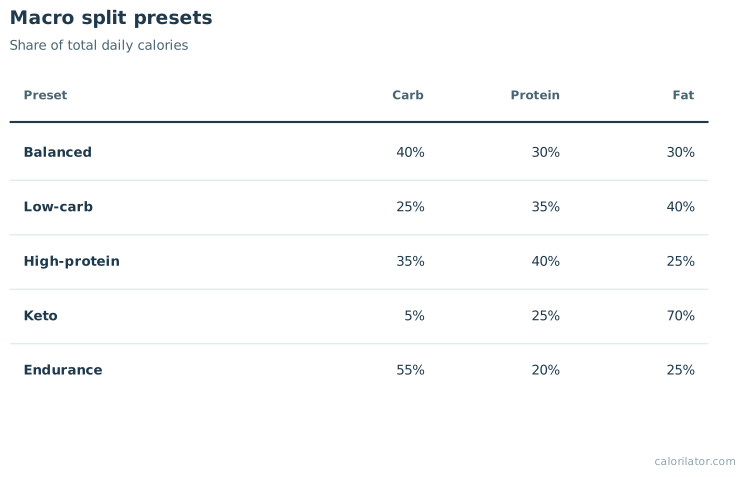
The fat percentage climbs fastest of the three across these presets, from 25% to 70% — for what actually separates a gram of saturated fat from a gram of unsaturated fat, beyond the calorie math here, see Healthy Fats Explained.
Why these five specifically
The five presets aren’t arbitrary — each maps to a genuinely common goal or eating style this site’s users search for and land on: a neutral default, a lower-carb preference, a muscle-focused goal, a very-low-carb metabolic approach, and a high-training-volume need. Five is enough to cover most common situations without the decision becoming its own source of overwhelm the way an unlimited menu of options might.
Balanced: the reasonable default
Balanced is a sensible starting point for anyone without a specific reason to lean toward one macro over another — moderate protein, moderate carbohydrate, moderate fat, none pushed to an extreme. It’s a reasonable choice for general health goals, for someone new to tracking macros at all, or as a baseline to compare other presets against once a specific priority becomes clearer.
Low-carb: for people who feel better on less carbohydrate
Low-carb suits people who’ve found — through direct experience, not just theory — that they manage hunger, energy, or blood sugar better on a reduced carbohydrate share, without going to keto’s extreme. At 35% protein, it also supports muscle preservation reasonably well, which is part of why it’s a common choice during a cutting phase for people who prefer eating this way.
High-protein: for muscle-focused goals
At 40% protein — the highest of any preset — this is a natural default for bulking or cutting phases where preserving or building muscle is the explicit priority. The remaining calories split fairly evenly between carbohydrate and fat, which keeps enough of both to support training without either one dominating.
Keto: a specific, demanding approach
Keto’s 5% carbohydrate ceiling is dramatically lower than any other preset, low enough to shift the body toward using fat and ketones as its primary fuel source rather than carbohydrate — a genuinely different metabolic state, not just “low-carb, but more.” This preset asks more of meal planning than the others, since very few carbohydrate-containing foods fit within a 5% share at all, and it isn’t inherently more effective for fat loss than other presets at a matched calorie deficit — it suits people specifically drawn to how it feels or performs for them, not a default best choice.
Endurance: built for training volume
At 55% carbohydrate, endurance is the mirror image of low-carb and keto — built for people with high, sustained training volume (distance running, cycling, competitive team sports) where carbohydrate availability directly supports performance and recovery. Protein sits lowest of any preset here (20%), not because protein matters less, but because the remaining calorie room is deliberately weighted toward the fuel source that matters most for this specific training demand.
A worked comparison at the same calorie target
At a 2,000 kcal target, the difference between presets is concrete, not abstract: balanced works out to about 200g carbs, 150g protein, 67g fat; high-protein to about 175g carbs, 200g protein, 56g fat; keto to about 25g carbs, 125g protein, 156g fat. Same total calories, three genuinely different eating patterns — which is exactly why picking a preset changes what a generated plan actually looks like day to day, even when the underlying calorie target hasn’t moved at all.
Picking between them isn’t about finding “the best” one
None of the five is objectively superior — weight change is driven primarily by the calorie target underneath whichever split is chosen, and macro split mostly changes which specific foods make up a plan and how it feels to eat, not whether the underlying calorie math works. The right choice depends on training type and volume, personal experience with hunger and energy on different splits, and any specific goal (muscle preservation, sustained endurance performance) the split is meant to support.
What research actually says about macro split and outcomes
Beyond the specific priorities each preset serves, controlled research comparing different macro splits at matched calories has generally found weight outcomes are far more determined by the calorie total and by adherence than by the specific carb-protein-fat ratio chosen — a split that’s easier for a specific person to sustain tends to outperform a theoretically “optimal” one that’s harder to stick with. This is part of why five different presets exist rather than one prescribed universal ratio: the best split is heavily person-dependent.
Custom splits, for when none of the five fit
The macro calculator also supports a fully custom split for anyone with a specific target in mind that doesn’t match one of the five named presets — a dietitian-recommended split, or a personal preference refined through experience. The only requirement is that the three percentages sum to 100; beyond that, a custom split is treated exactly the same as any preset by the rest of the calculator.
Presets and diet pattern are two separate choices
It’s worth keeping macro preset separate from diet pattern (vegetarian, vegan, Mediterranean, and so on) in your head — the two combine independently. A vegan pattern can run on a balanced, high-protein, or low-carb macro split just as an omnivore one can; picking a diet pattern answers “which foods,” while picking a macro preset answers “in what ratio,” and neither choice constrains the other.
Switching presets without starting over
Changing presets partway through a plan changes how the same calorie target divides between carbs, protein, and fat — and therefore which foods a generated meal plan selects — without requiring a new calorie target or a new goal. This makes it reasonable to experiment: trying balanced for a few weeks, then switching to high-protein or low-carb to see how it feels, without losing progress on the underlying calorie target driving everything else.