“Best protein source” doesn’t have one single answer, because it depends what’s actually being optimized for. A food that ranks highest by protein density isn’t necessarily the cheapest, and the cheapest isn’t necessarily the most versatile across a week of different meals. Here’s a grounded look at all three, rather than one list pretending to answer all of them at once.
Most “best protein sources” lists online quietly pick one of these three axes without saying so, then present the result as a single objective ranking — which is how a list optimized purely for density ends up looking odd to someone shopping on a budget, or a budget-first list looks incomplete to someone specifically trying to maximize protein per calorie.
Why “best” needs a definition before it needs an answer
Skipping straight to a list without picking an axis first is how most generic “best protein sources” content ends up either too vague to act on or quietly biased toward whichever priority the writer had in mind without saying so. Naming the actual goal — density, cost, or versatility — first makes the rest of this genuinely useful rather than another list to skim past.
What “high-protein” means on this site
This site’s high-protein classification uses a specific, checkable rule: protein must supply at least 30% of a food’s total calories, calculated as protein grams times 4 (protein’s calories per gram) divided by total calories. That’s a density measure — it captures how concentrated a food’s calories are toward protein specifically, which is a genuinely different question from how many total grams of protein a typical serving provides.
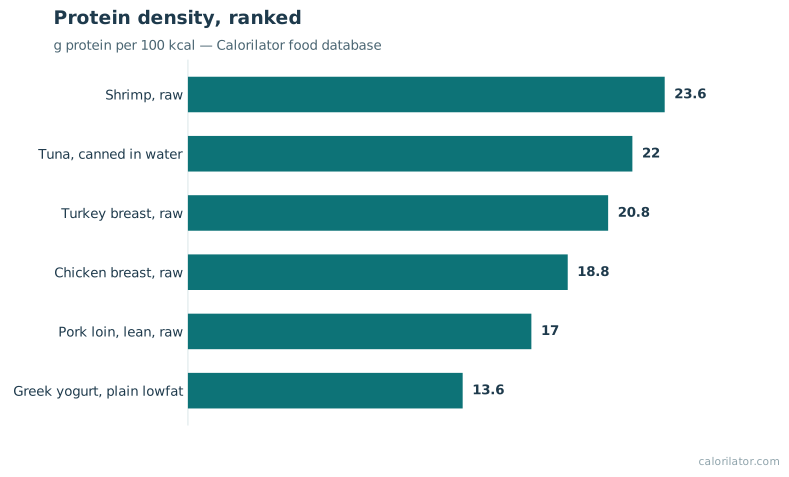
Ranking by protein density
By this specific density measure, very lean meats and fish, egg whites, and non-fat dairy (cottage cheese, plain non-fat Greek yogurt) tend to rank highest, since they carry protein with comparatively little fat or carbohydrate diluting the calorie total. A fattier cut of the same protein source — salmon versus cod, a whole egg versus egg whites — still delivers meaningful protein, just at a lower percentage of its total calories, because the additional fat adds calories without adding protein.
Density versus absolute grams per serving
Density and absolute grams answer different practical questions. A food can supply a large, useful amount of protein in a typical serving without hitting the 30%-of-calories threshold — whole eggs and salmon are common examples, both genuinely good protein sources that carry enough fat to pull their percentage below the density cutoff. For someone specifically trying to maximize protein while minimizing calories, density is the more relevant measure; for someone just trying to hit a daily gram target without much concern for total calories, absolute grams per serving often matters more.
Complete versus incomplete proteins
Animal protein sources are complete on their own — they contain all essential amino acids in sufficient amounts. Many individual plant sources are lower in one or more essential amino acids, though combining sources across a day (beans with rice, for example) resolves this in practice, since the body doesn’t require every essential amino acid from a single meal to use protein effectively. This matters for variety more than it does for any single meal’s composition.
Animal protein sources worth knowing
Chicken breast, white fish, and egg whites sit toward the leaner, higher-density end; salmon and other fatty fish carry more calories per gram of protein but bring genuinely valuable omega-3 fats along with it; non-fat Greek yogurt and cottage cheese are both dense, versatile dairy sources that work as easily in a savory dish as a sweet one. None of these is inherently “better” than another — they suit different meals, budgets, and preferences.
Whole cuts of meat, fish, and eggs are also worth favoring over reformed or breaded protein products (nuggets, patties built from reconstituted meat, flavored protein bars) on general processing grounds, separate from any single nutrient this ranking captures. Our piece on a 2026 study linking higher ultra-processed food intake to prostate cancer risk covers one specific, newer reason that case has gotten stronger, alongside the honest limits of that evidence.
Plant protein sources worth knowing
Legumes (lentils, chickpeas, black beans) combine meaningful protein with fiber and are among the most budget-friendly options available. Tofu and tempeh both take on flavor well and hold up to a range of cooking methods — pressing tofu and briefly steaming tempeh both improve texture and flavor absorption before cooking. Seitan, made from wheat gluten, is unusually protein-dense for a plant source, though it isn’t suitable for anyone avoiding gluten.
Building variety into a real week
Rotating between a handful of protein sources across a week, rather than repeating one at every meal, covers a wider range of accompanying nutrients — iron and B12 concentrated in meat, omega-3s in fatty fish, fiber in legumes — none of which show up in a protein-percentage or protein-gram ranking alone, since those measures only capture the protein itself. This is less about any single food being deficient and more about the practical benefit of a varied diet doing work that a single-nutrient ranking, however useful, can’t fully capture on its own.
Cost and versatility, not just density
A relative look at protein cost generally puts dried legumes, eggs, and canned fish at the cheaper end, with fresh boneless cuts of meat and fish at the more expensive end — a ranking that doesn’t always match the density ranking above. Versatility matters too: a protein source that works plain, in a sauce, cold, and reheated (chicken thighs, eggs, legumes) is genuinely more useful across a real week of varied meals than one that only works well prepared one specific way.
That protein-source cost gap is also the single biggest driver behind the difference in what full diet patterns cost per week — our 2026 breakdown of grocery cost by diet pattern prices real 7-day plans across eight patterns and finds a roughly 2x gap between the cheapest and most expensive, almost entirely traceable to which end of this protein ranking a pattern leans on.
A note on protein quality scoring
Beyond “complete versus incomplete,” nutrition science uses formal scoring systems (like DIAAS or the older PDCAAS) to rate how efficiently the body can actually use a protein source’s amino acid profile, accounting for digestibility as well as composition. Animal proteins and soy tend to score highly on these systems; most other individual plant proteins score somewhat lower on their own, which is the more technical version of the same “combine plant sources across a day” advice already covered above — the practical takeaway doesn’t change, just the precision behind it.
A worked comparison: two ways to hit the same target
Consider a 150g daily protein target hit two different ways: entirely from chicken breast, or split across eggs, Greek yogurt, lentils, and salmon. Both approaches can reach the same gram target, but the second spreads out cost, brings a wider range of accompanying nutrients (omega-3s, calcium, iron, fiber), and is generally easier to sustain without the monotony of eating the same food at every meal. Neither approach is “wrong” — the first is simpler to plan around, the second is more nutritionally diverse — but it’s worth knowing both reach the same number by very different routes.
Using the ranking practically
None of these rankings is the “correct” one to use — the right choice depends on whether the goal is maximizing protein density, minimizing cost, or maximizing how many different meals a source can realistically become across a week. The high-protein foods list applies the density rule described above against this site’s verified food database, which is a useful starting point regardless of which of the other priorities matters most for a given week.
A reasonable default for most people is picking two or three sources from different points on these rankings — one dense and convenient, one budget-friendly, one especially versatile — rather than searching for a single “best” food that wins on every axis at once, since no single source realistically does.